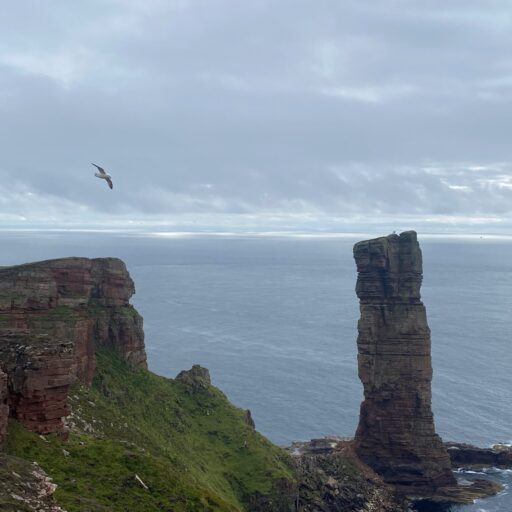
Amazingly, I climbed this stack for a second time with friends Ryan and Rob this month – March ’26.
See an engrossing account by Ryan here –
https://ryangilmour.github.io/2026/03/18/the-candlestick.html
Our team this year was strong, and my prior knowledge of the techniques and skills required, useful.
The mystery of challenges to overcome was definitely some of the draw of this adventure, so at risk of trying to bring the challenge down some levels, I offer freely some practical advice with abseils, Tyrolean traverses and escape.
I feel some responsibility to share some practical advice, as my previous narrative blog was likely unhelpful (but hopefully entertaining) to anyone wishing to attempt the ‘stick.
See here –
Through a series of expertly illustrated diagrams and stepwise instructions, I hope others might be able to make a successful and safe passage to and from the stick. A real account of how you ‘get the rope up there’.
Disclaimer – I do not take any liability for usage of these techniques. Rock climbing is inherently dangerous, can result in injury or worse. Anyone considering an ascent of a sea stack such as this in Tasmania, should have suitable fitness, experience, knowledge and skills for such an undertaking. And on top of that, make fair judgement of any fixed equipment they encounter.
I am not a guide. This blog is not a replacement for a guidebook or The Sarvo. These are just techniques I found useful. Be sure you pack extra ‘psyche’ as well.
This series of steps makes some assumption about the reader as well with technical terms and steps taken for granted: e.g. always being clipped into a belay safely, and making sure there is a back up attachment to each rope so you don’t lose any to the sea or abyss.
Anyway, now that’s out the way, check out what we did.
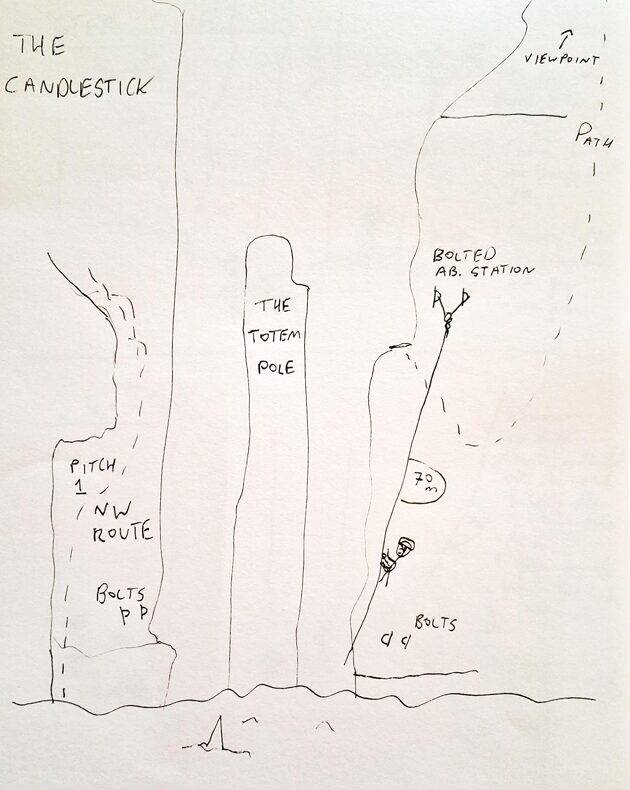
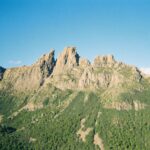
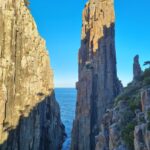
The candlestick is at Cape Huay, a good 5.5km hike each way from Fortescue Bay, and lots of uphill taking a ‘guidebook time’ of c1h 30m to the viewpoint.
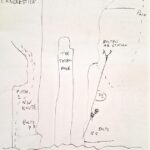
The fixed abseil point, roughly level with the top of the Totem pole is several metres and minutes of scrambling down a rough path.
Once arrived, watered, changed, braced and ready for the mission. This rough guide is an option to follow for Tyrolean traverses. Covering the principles applied to the Candlestick here rather than every minute detail.
Kit list:
We took – one 70m single rope and 2x 60m ‘double ropes’
An ‘ATC’ (Air Traffic Controller) or tubular belay device, gri-gri, several slings and at least 3 prusiks as a minimum. 5 lockers as a minimum. Each. A petzl traxion and ascender may also be useful.
Other combinations available and possible to use with the steps provided here.
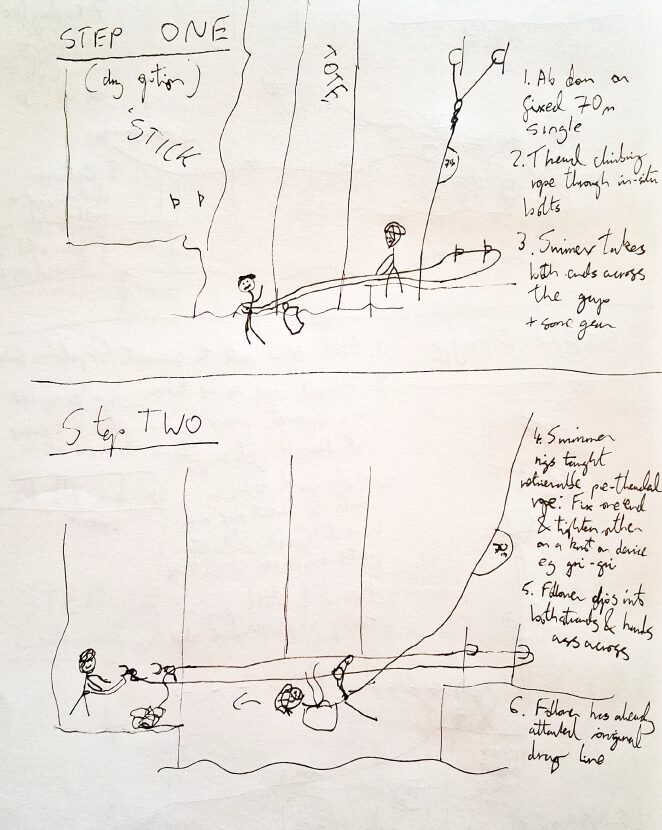
Step ONE
Fix a 70m single rope to the two ring bolts found on the mainland side.
(You have a couple options here, we opted to equalise as much as possible for an ‘upward pull’ towards the ‘stick’ rather than in direction of abseil – important later, though note this means the last person will be abseiling essentially off one bolt)
- Abseil down on the 70m single to a sea washed platform opposite the tote and the ‘stick
- Thread a climbing rope to its middle through in situ bolted anchors.
- One person swims across the gap, either taking gear in a dry bag or hauling tethered to the rope afterwards (as I did on the first outing)
Mind the swell.
Step TWO
- 1st person having safely scaled the kelp, rigs a Tyrolean on this pre-threaded climbing rope, fixing one end to the bolted anchors and tensioning the other on either a hitch or device eg gri-gri
- Follower clips into both strands and hauls ass over the sea to join swimmer
- Follower has already ensured they have fixed and tethered end of abseil line to themselves – to be dragged up the ‘stick throughout
Note this Tyrolean traverse is actually optional. If preferred, and recommended by the guidebook, you could all swim with gear in dry bags and tether the abseil line to yourselves or the bags.
This is a less dry option and misses an opportunity to rig a Tyrolean low over water ‘in-anger’. You decide.
Step THREE
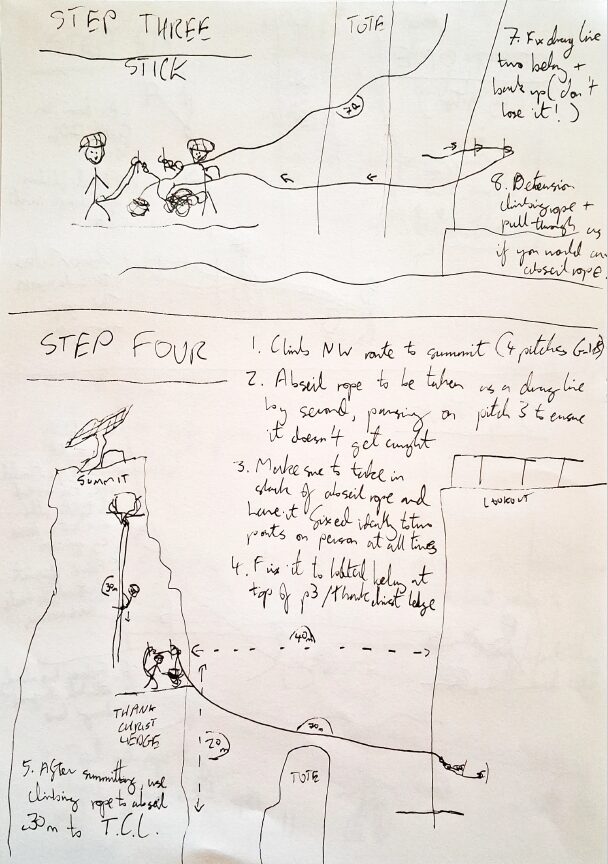
- Fix drag line to belay and follower – ideally always ensure it is fixed in two places to aid with managing slack and make sure you don’t lose its end – it is your key method of escape
- De-tension climbing rope, ensure all stoppers or back-ups are removed and pull one end through the mainland anchors, as you would a retrievable abseil
Step FOUR
- Climb NW route to summit – 4 pitches up to grade 18, 1st pitch is crux and often wet. Do not underestimate the difficulty of this route. It commands respect and serves as a great apprenticeship in becoming a well-rounded adventure trad climber, if that’s your bag. You probably want your max trad ‘onsight’ to be a grade or two ‘in-hand’ here.
- Ensure abseil rope is always tethered to the second person, as a drag line. Pause on pitch 3 to ensure you can drag it around the sharp corner, not getting it stuck.
- Take in slack on this line as you go, and coil the excess rope to the end in a suitable tidy way, or put it in a bag.
- Once shuffled over to the bolted belay at the ‘thank Christ’ ledge after pitch 3, fix the original abseil line to here at a couple of places and leave it there for later.
- Once you all summit, celebrate and wave to your fans on the lookout (if present), abseil 30m back to the thank Christ ledge off slings.
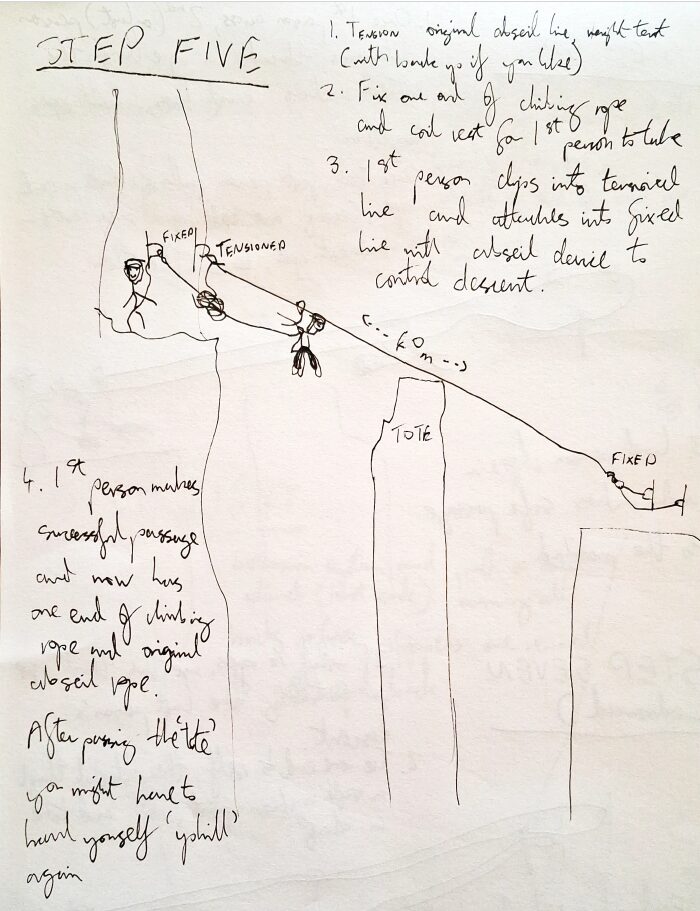
Step FIVE
The escape Tyrolean will make the first one over the waves feel like it was just for laughs.
The bolted belay on the Candlestick’s ‘thank Christ’ ledge is 20m above vertically and 40 metres (approx.) from your original abseil point on the mainland. This creates two key problems to solve – it is longer than half of a 70m rope, and you will have to descend 20m.
The following steps aim to solve these problems by tying two ropes together and descending using an abseil device.
- Tension original abseil line and tie off – hand tensioning and using a gri-gri (tied off) should suffice here however there are many ways to skin a cat.(weight test if you prefer)
- Fix one end of climbing rope to bolts and coil rest of rope to end for 1st person to take on a sling
- 1st person attaches into fixed line (the climbing rope) with abseil device to control descent and clips into tensioned line with a locker
- 1st person makes successful passage to mainland feeding fixed climbing rope out controlling their descent. They now are on the mainland with both the end of the climbing rope and fixed end of the original abseil line.
Note after passing the tote, you may have to haul yourself ‘uphill’ for a few metres to the mainland. And getting off the ropes is also a challenge under load, so make sure you’re always backed up to the anchors with a sling or suitable personal attachment system.
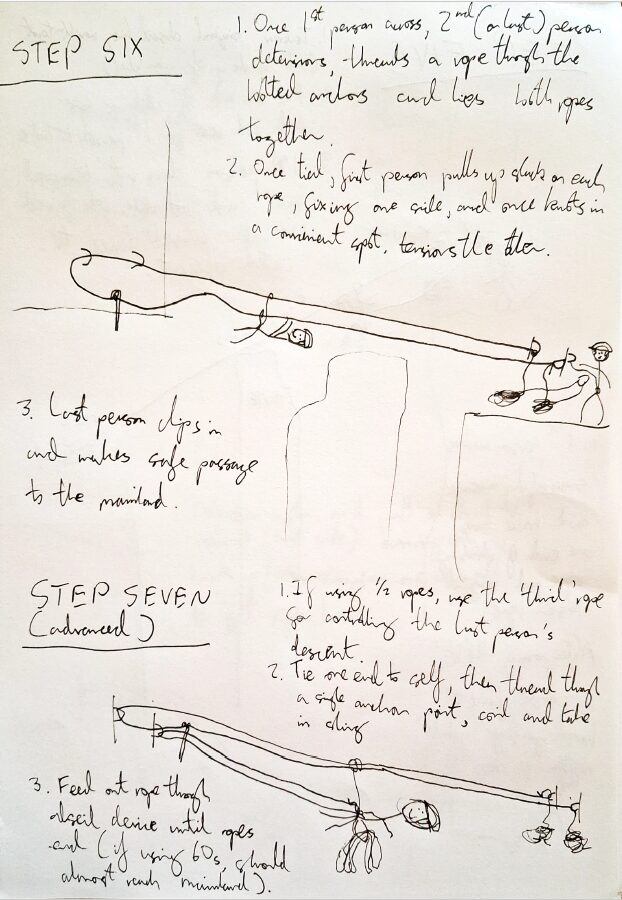
Step SIX
- Once 1st person across, last person de-tensions system.
- Then last person threads rope through bolted anchors on stick side, and ties both ropes together
- Note the threading and tying of ropes can be done before any passage to mainland, be cautious with the loads on a Tyrolean traverse being higher and unusual vs abseiling. Be cautious with ropes which are different thicknesses. Consider knot used carefully. A Gibb’s offset bend may be of use here.
See – https://www.andy-kirkpatrick.com/blog/view/rappel-knots-1
- Once tied and de-tensioned, with clear communication, first person pulls up slack on each rope, fixing one side and tensioning the other eg on gri-gri tied off. Ensure joining knots on candlestick side are in convenient place, close to the anchors so the last person can attach themselves downstream of them. This avoids creating another problem to overcome.
- Last person clips in and makes safe passage to the mainland
Step SEVEN (advanced and one option for the last person)
How will the last person control their descent you ask? Won’t they simply slide down this zipline and splat into the mainland cliff?
Ah! Well if you like doing it for Britain with double ropes, never fear, you can use a ‘third’ rope!
- If using half ropes (recommended), use the third rope for controlling the third person’s descent
- Thread one end through anchor point and tie to self as normal using a figure of eight
- Coil rest of rope to end and attach coils to harness using a sling
- Attach self to other strand with an abseil device and once clipped into both strands of tensioned Tyrolean, use the third rope as a means to control descent by abseiling
- Close to mainland, after the difficulty of passing the ‘bow’ of the rope, you will likely encounter the end of the third rope feed through your abseil device. This would normally be a problem, however we are on a tyrolean traverse, not an abseil so it is possible to do this and haul self to the anchors and victory. For simplicity, it would make sense to now pull this rope through and retrieve before the next step.
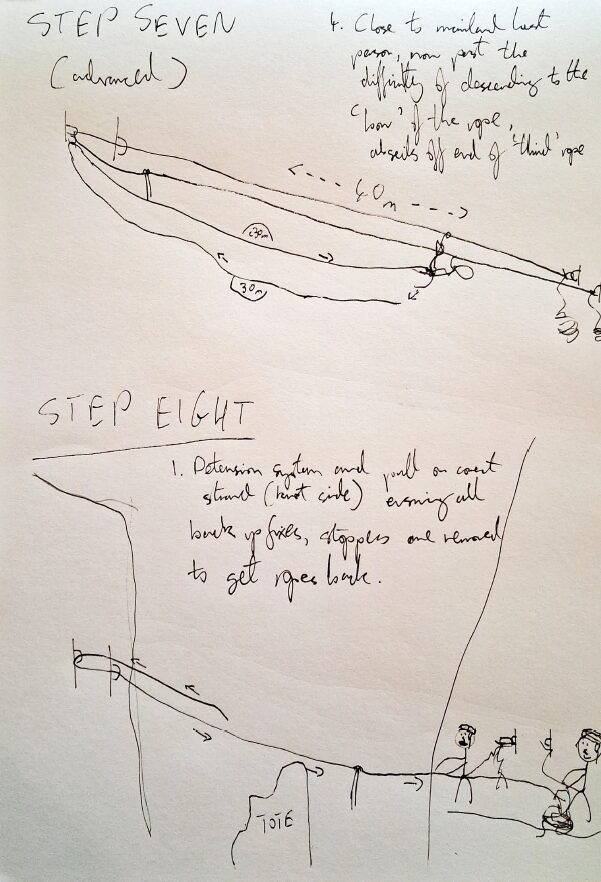
Step EIGHT
- Now all safely back on mainland and clipped into the anchors, de-tension system and pull on agreed and correct rope strand (the one knot side of the anchors, just like abseiling) ensuring all back-up fixes, stoppers are removed, to get ropes back
Note that the anchors on the candlestick are a bit oxidised, not textbook and ensure you make your own judgement around their safe use. Equalising and distributing the load between the two points is probably a good idea.
Much friction can be created in this system and pulling the ropes may be challenging especially in windy conditions, ensure deck is stacked in your favour by removing any twists or folds in the rope and working as a team to pull them correctly.
Now you have successfully completed this part of the mission, now you can eat, drink, scramble to the lookout to speak to fans and head back to Fortescue for a swim and a beer, just continue to be on the lookout for snakes and opportunistic photographers.
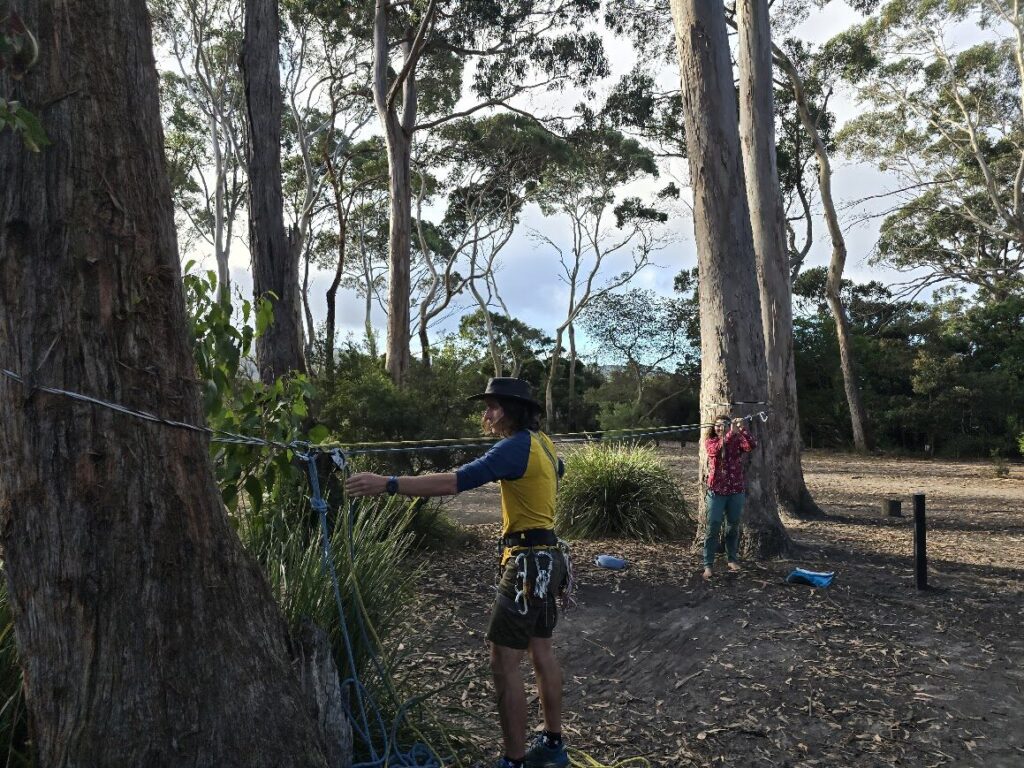
I recommend a dress rehearsal in Fortescue Bay campsite the night before by rigging a Tyrolean between two trees – use slings around trunks to simulate bolted belays. Strip if you want to simulate a swimmer. Practicing all steps and agreeing a suitable plan before the climb here is invaluable.
To any would-be Candlestickkers, if this blog has created debate, rejection of the techniques above in favour of others or food-for-thought prior to your ascent, then I can only say I have succeeded. And good luck.
Leave a Reply